
Notes from the clinic #3
by Brian Curry (MA, BACP)

0. He was, he said, obsessed with this picture of Wittgenstein,
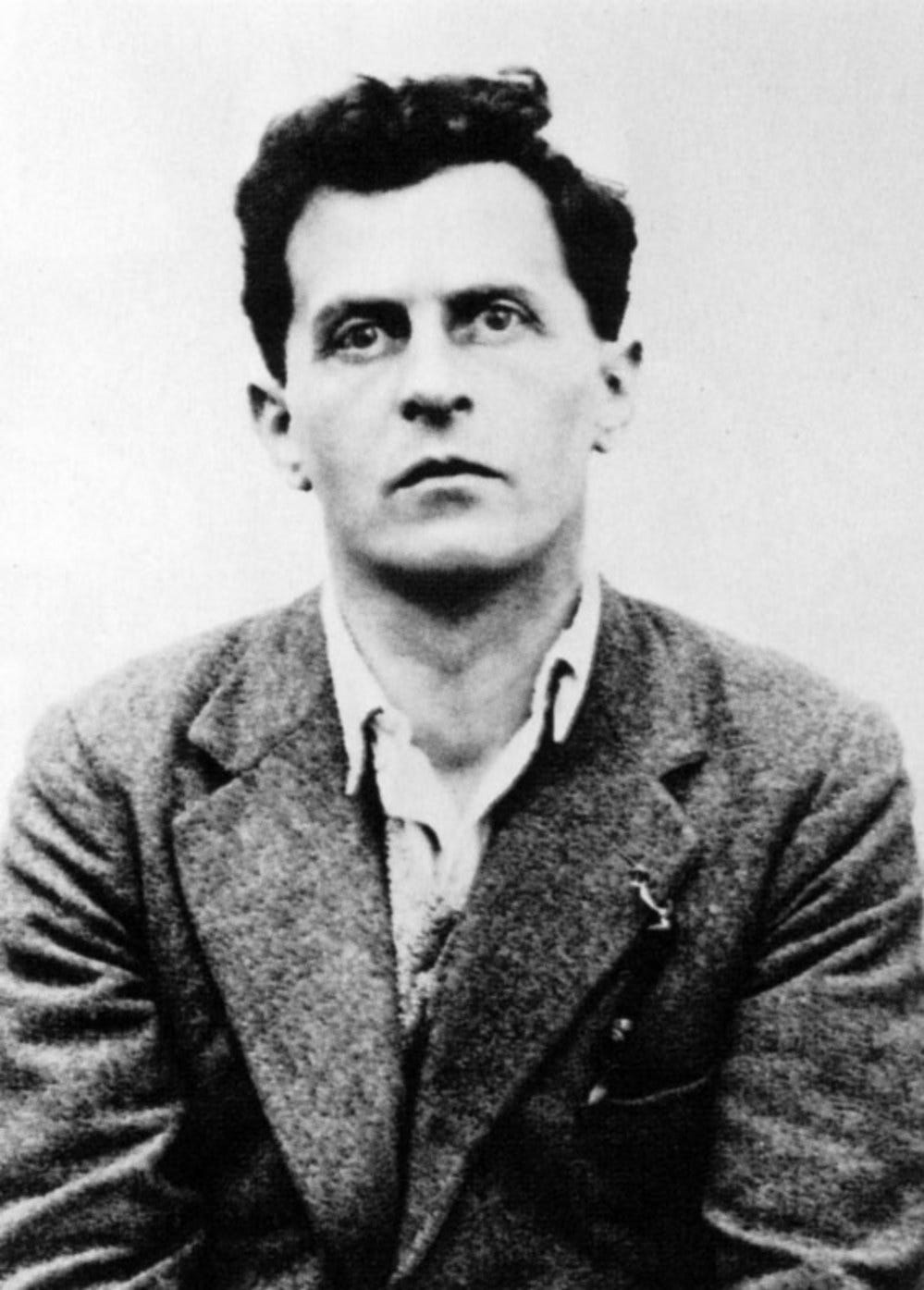
and said that he tries constantly to look with his eyes in the way Wittgenstein was looking with his eyes in this picture, and to reverse engineer his (Wittgenstein’s) gaze, trying to put his mind in a state just like Wittgenstein’s was in the picture, and he tried to gaze in a Wittgensteinian manner, a manner suggestive of the thinker – very abstracted, very intelligent – but whenever he tried to adopt this gaze-pose he knew that he wasn’t thinking the thoughts or philosophy that Wittgenstein was thinking when he was gazing in the manner he was gazing in in the picture, and that while he was seeking to think philosophical thoughts via adopting Wittgenstein’s gaze, he was simply thinking of himself looking like Wittgenstein looked, or rather, asking himself whether he did in fact look the way Wittgenstein looked, or whether he simply looked like someone imitating that look, and he wondered what people thought of him looking like this, and whether they would recognise his Wittgensteinian stance or gaze, and in this way, he was concerned that in trying to think like Wittgenstein by trying to gaze like Wittgenstein, he was in fact doing the opposite of Wittgenstein, who we can be sure, or as close to sure as possible, wasn’t thinking at all about his gaze when he gazed, but gazed in a Wittgensteinian way quite naturally.
1. He said that he couldn’t eat because he could find no sharp boundary between food and shit and he reasoned that because he couldn’t eat shit, he wouldn’t eat food either, until, that is, a clear boundary could be established which precisely defined food and which clearly separated it from shit. He further said that he had a recurrent dream in which all food was in fact reconstituted shit. He believed (outside the dream, in conversation) that this dream idea was in fact going to become a reality in the near future in an attempt to create a zero-waste planet. All our shit would be fed into machines which would produce food such as bagels and hummus from shit, in what in the dream was called the beautiful circle, and he also believed, based on his own personal supermarket research into bagels and hummus, that this process has already reached experimental stage, and that when it is rolled out nationally and internationally, he said, he will prefer to starve than to eat shit and that when this nationwide and internationwide roll-out happens, and perhaps even sooner, he will begin only to eat the vegetables he has himself grown and can trust.
2. He said that he had a dream and in the dream God would offer souls, before being attached to a body, various kinds of life, and that God had offered his soul a premium life experience, with all the benefits that this came with. Yet his soul, smelling a rat, refused the offer, and having refused the offer he now has only a budget life experience, cramped and with none of the benefits he could have been enjoying had he taken up God’s offer of a premium life experience. And he said he felt a fool in the dream for being so doubtful, so mistrustful, especially given that God is an omnibenevolent being, for now he must live an entire budget life and have only budget experience whereas he could have been enjoying a premium life and premium experience.
3. Any growing thing has the structure of a tree, he said, and if he couldn’t be part of the tree of life, then he wants to be part of the tree of history, or some other tree such that he would have descendants of some sort, the worst thing, he said, was not to be part of any tree, to fall outside the tree of life and any other tree, and to have no descendants, and so not to be part of something growing, but to be, as he put it, inorganic, by which he meant: the end of a line, the final stop.
4. It's all a big joke, he said, in reference to his writing and speaking. He said he wanted to write and speak in the manner of Kant, that is, unironically and unsocratically, directly and seriously and scientifically, and to be taken in all seriousness as such, and yet, he said, he couldn’t speak or write without finding his tongue in his cheek, despite the fact that everything he thought was thought, he said, with the force of utmost seriousness, but when it came out in words – in type or voice – it became unserious, thumbing his own nose at his own words and thoughts. He said, in a very serious manner, that he was very concerned about this detachment from himself, that he was concerned that if it continued he might lose touch with his life altogether, that is, cut the threads attaching him to his own life through the overuse of self-irony, and that he might depreciate himself to death.
5. He said he would often make a face about something he was thinking about, and then find that he was looking at someone who was also looking at him make this face which they were interpreting, he thought, as being directed towards them. And now he was in a bind: if he suddenly changed his face it would seem to them that he had in fact been looking at them all along and had, as it were, been caught. And this would be a lie, for he was not making the face in response to them, only accidentally looking at them. And so he carried on holding the face and carrying on with the face so as to appear to them as if the face wasn’t directed at them at all, and now he was stuck with this face – and stuck in a lie – which was responding to something merely thought of, which wasn’t there in the visible world, or the common or public world, but only in his mind, and now the question he faced was how and when to drop the face and return to his ordinary facial position. And it is this, and things such as this, he said, which makes life so hard.
6. He said he didn’t want to inform anyone about his (mental) sickness, that he would prefer to suffer in silence rather than inform anyone of it, though his ideal situation would be that they would come to understand that he was (mentally) sick by working it out for themselves, like an intuitive mother would do. It is possible, he said, that they all know he is mentally sick, and perhaps even speak to one another about it, but they haven’t discussed his mental sickness with him, and that as usual, he will be the last to know of his mental sickness.
7. He said he felt twisted inside and that he could only operate in the world being twisted inside, that it was somehow this twist that allowed him to pick up wind in his sails and go forward, and his greatest fear was that this twist, which caused him great suffering, and occasional joy, should be resolved and flattened out, for in this flattened out state (happiness) he would no longer know what to do, and he feared that in such a state he would no longer be able to pick up any wind nor move forward.
8. He said he was a waiter, that is, he waited for others to take him under their wing and sort things out for him but that he would never trust anyone’s motives for doing this, and so he would refuse all such interventions by such angels. And in any case, he said, no one has offered to do these things for him, and that in any case, everyone is so turned in on themselves they are not even interested in his case, they are each working on their own cases, and so he would probably be waiting a very long time for such a person to work on his case.